
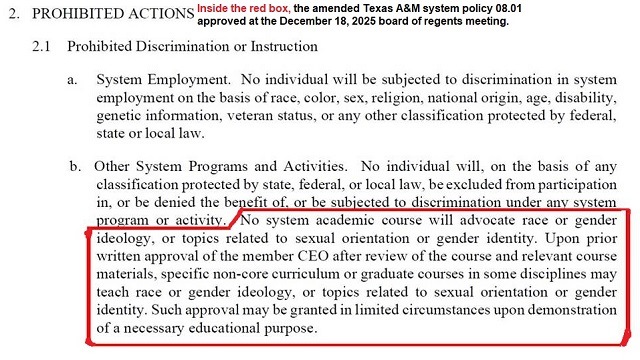
When spring semester classes start Monday at Texas A&M, at least one educator will be affected by a new board of regents teaching ban.
Philosophy professor Martin Peterson, who has been at A&M since 2014, agreed to comply with the order to remove from lectures that incorporate the Greek philosopher Plato that his department head said violated the system’s ban on teaching race and gender ideology.
Dr. Peterson says constitutional protections for free speech and academic freedom take priority over the board of regents policy.
He also says his job “is not to tell them (students) what to think. I’m just trying to help them structure their thoughts and arguments for and against. It’s up to help them (students) make up their own mind. I’m not advocating for any ideology. I leave it to them (students) to decide what to think.” Peterson says that will result in making repeated disclaimers to that affect in the classroom during the semester.
====================================
Peterson provided to WTAW News, the notice he received from his department head, which told him to submit his course syllabus as the result of the board of regents decision in December 2025. The department head’s notice said Peterson’s Contemporary Moral Issues class, as a core curriculum course, could not include issues related to race ideology, gender ideology, or topics related to sexual orientation or gender identity.
When Peterson submitted his syllabus to his department head, which he told WTAW News this was the first time he was required to do in his 12 years at A&M, he referred to the submission as a “mandatory censorship review.”
Peterson went on to write to his department head:
“”The syllabus has not changed much since I last taught the course. I have made some minor adjustments to the module on Race and Gender Ideology and to the lecture on Sexual Morality. These topics are commonly covered in this type of course nationwide, and the material is discussed in depth in the assigned textbook (Fiala and MacKinnon, 10th edition). I also ask my students to read a few passages from Plato (Aristophanes’ myth of the split humans and Diotima’s Ladder of Love).
Please note that my course does not “advocate” any ideology; I teach students how to structure and evaluate arguments commonly raised in discussions of contemporary moral issues.
If you interpret System Rule 08.01 §2.1(b) as prohibiting these topics, I would like to remind you that the U.S. Constitution protects my course content. Texas A&M is a public institution bound by the First Amendment. The Supreme Court has noted that academic freedom is “a special concern of the First Amendment, which does not tolerate laws that cast a pall of orthodoxy over the classroom (Keyishian v. Board of Regents, 385 U.S. 589, 603 [1967].
Another relevant precedent is Sweezy vs. New Hampshire. Here is Chief Justice Earl Warren for the majority in 1957:
“The essentiality of freedom in the community of American universities is almost self-evident. No one should underestimate the vital role in a democracy that is played by those who guide and train our youth. To impose any straitjacket upon the intellectual leaders in our colleges and universities would imperil the future of our Nation. No field of education is so thoroughly comprehended by man that new discoveries cannot yet be made. Particularly is that true in the social sciences, where few, if any, principles are accepted as absolutes. Scholarship cannot flourish in an atmosphere of suspicion and trust. Teachers and students must always remain free to inquire, to study and to evaluate, to gain new maturity and understanding; otherwise, our civilization will stagnate and die.” (354 U.S. 234, 250 [1957], my emph.)
Restrictions on teaching based on viewpoint discrimination are unconstitutional under nearly all circumstances. If faculty are required to seek prior administrative approval for classroom content, that raises serious concerns about “prior restraint.” Courts have repeatedly distinguished between holding faculty accountable after the fact (for alleged misconduct) and imposing advance censorship of course conduct. Moreover, restrictions that single out specific perspectives as more problematic than others have repeatedly been found unconstitutional (Rosenberger v. Rector and Visitors of the University of Virginia, 515 U.S. 819 [1995]; Healy vs. James, 408 U.S. 169 [1972]).
In Garcetti vs. Ceballos (547 U.S. 410 [2006], the Supreme Court discusses limits on public-employee speech. However, the Court explicitly set aside the question of whether its analysis applies to “speech related to scholarship in teaching” (id. At 425).
I also note that Texas A&M is a signatory to the 1940 Statement of Principles on Academic Freedom and Tenure, which affirms that faculty are entitled to ”freedom in the classroom in discussing their subject…[and that] limitations of academic freedom because of religious or other aims of the institution should be clearly stated in writing at the time of the appointment.” I was hired in 2014, when Texas A&M was an ideologically neutral institution, and I was not informed of any ideologically motivated limitations on academic freedom of the kind recently announced.
Even if you were to conclude that my syllabus conflicts with System Rule 08.01, constitutional protections for free speech and academic freedom would control. As a public institution, Texas A&M should not enforce policies that raise serious constitutional concerns. When a system rule appears to conflict with the First Amendment, administrators should in my opinion proceed with caution and seek legal guidance rather than mechanically apply the rule.
I have cc’ed Interim Dean North, as the questions raised in this message may warrant evaluation at the college or system level before a final determination is made.””
====================================
After submitting his syllabus, Peterson was told by his department head that “The College leadership team and I have discussed your syllabus and the Provost office’s requirements with the new system rule 08.01. You have two options going forward:
1. You may mitigate your course content to remove the modules on race ideology and gender ideology, and the Plato readings may include these.
2. You may be reassigned to teach PHIL 482 501-514. Lecture times for this course are T/TH 8:00-9:15.”
====================================
Peterson shared with WTAW News, his response to the department head:
“Your decision to bar a philosophy professor from teaching Plato is unprecedented. Colleagues and journalists around the world have already contacted me for comment. You are making Texas A&M famous—but not for the right reasons.
After consulting with legal counsel regarding your ultimatum, I have chosen Option 1. I will revise my syllabus and replace the censored material with lectures on free speech and academic freedom. I will share my revised syllabus tomorrow.”
Peterson told WTAW News on January 8 that he has not received a response from his department head about the status of his revised syllabus. He said he is “not worried or stressed or losing sleep over this”, adding “I think the word disappointment is what best captures my attitude”.
====================================
At the request of WTAW News, Texas A&M sent the following statement:
Texas A&M University will teach numerous dialogues by Plato in a variety of courses this semester and will continue to do so in the future. In alignment with recent System policy, university administrators are reviewing all core curriculum courses to ensure they do not teach race or gender ideology. Recently, the head of the Department of Philosophy rejected one section of Philosophy 111, a core curriculum course, because the professor slated to teach the class had included modules on gender and race ideology. These titles were added following the new policy approved by the Board of Regents specifically prohibiting the teaching of such ideologies. The Department Head advised the professor that he may teach the course if the modules that do not align with the new policy are removed. If the professor chooses not to comply, the section will be reassigned to another professor to ensure our students can move forward with the course they registered for without interruption. Other sections of the same course have been approved, meet learning outcomes and include works by Plato but do not include modules on race and gender ideology.
====================================
WTAW News requested and received Dr. Peterson’s response to Texas A&M’s statement:
They seem to be saying that the fact that *some* dialogues by Plato can be taught at A&M is good enough — the fact that others have been banned is nothing to worry about. If that is the university’s view, I disagree. At a real university, we should be permitted to discuss *all* of Plato’s dialogues. It is false that I added modules on race and gender ideology—the modules and their contents are the same as when I taught the course in F 2024, I have just updated the description in the syllabus to reflect the university’s current terminology: the old heading was “race and gender issues”, it’s now “race and gender ideology”.
WTAW News was made aware of the order given to Dr. Peterson by the organization Foundation for Individual Rights and Expression (FIRE). Their statement says the board of regents policy that was adopted in December 2025 “strips faculty of the ability to determine curriculum around issues of “race or gender ideology” and “sexual orientation,” placing that power entirely into the hands of the institution’s leadership. That’s a fundamental assault on academic freedom, and the First Amendment prohibits public universities from deciding which viewpoints can be taught in a classroom and which must be banished.” The statement also says “Texas A&M now believes Plato doesn’t belong in an introductory philosophy course. The philosophy department is demanding that professor Martin Peterson remove Platonic readings because they “may” touch on race or gender ideology. He’s been given until the end of the day to comply or be reassigned. This is what happens when the board of regents gives university bureaucrats veto power over academic content. The board didn’t just invite censorship, they unleashed it with immediate and predictable consequences. You don’t protect students by banning 2,400-year-old philosophy.”
Click below to hear Dr. Martin Peterson’s interview with WTAW’s Bill Oliver.