The Texas A&M College of Veterinary Medicine and Biomedical Sciences will house a new research center funded by a grant from the National Institutes of Health (NIH).
A news release says the five year, $15.3 million dollar grant will advance modern, science-based approaches that improve and accelerate chemical safety assessments while reducing the need for new animal testing.
A multidisciplinary team of toxicologists, engineers, data analysis experts, regulatory professionals and educators will address barriers that have limited regulatory acceptance of non-animal methods, particularly for non-pharmaceutical chemicals used in everyday products and industrial applications.
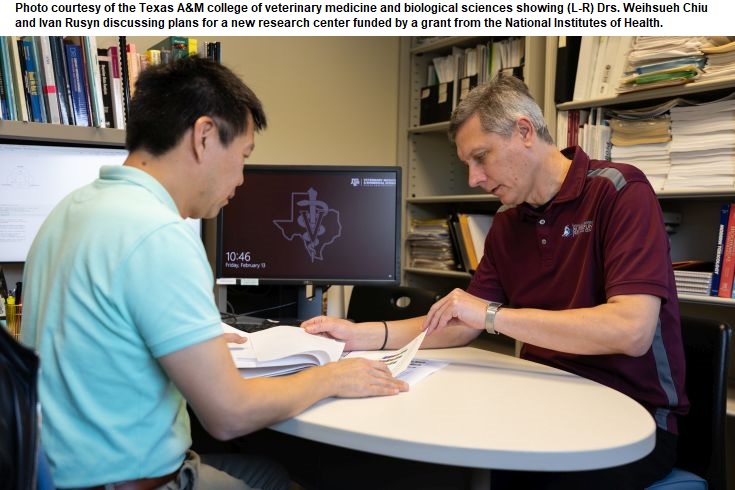
Attached is a photo that Dr. Rusyn had approved for the story. Caption option: Drs. Weihsueh Chiu (left) and Ivan Rusyn discuss the plans for Center research
News release from the Texas A&M college of veterinary medicine and biological sciences:
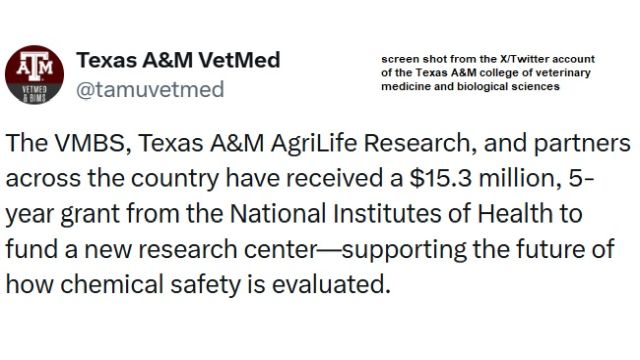
The Texas A&M University College of Veterinary Medicine and Biomedical Sciences (VMBS), Texas A&M AgriLife Research and partner institutes from across the country have received a five-year, $15.3 million National Institutes of Health (NIH) grant to fund a new research center that aims to transform how industrial and consumer-use chemicals are evaluated for human safety.
Funded through the NIH’s Common Fund Complement-Animal Research in Experimentation (Complement-ARIE) program, the New Approach Methodologies (NAMs) Decision Center will advance modern, science-based approaches that improve and accelerate chemical safety assessments while reducing the need for new animal testing.
The NAMs Decisions Center brings together a multidisciplinary team of toxicologists, engineers, data analysis experts, regulatory professionals and educators to integrate NAMs — advanced, human based laboratory models and computer-based tools — into real-world regulatory decision-making. Partner institutions include the University of North Carolina at Chapel Hill, the University of Illinois Chicago, Michigan State University, North Carolina State University and Sciome LLC.
Together, these scientists will address barriers that have limited regulatory acceptance of non-animal methods, particularly for non-pharmaceutical chemicals used in everyday products and industrial applications.
“Chemical safety decisions affect virtually everyone because chemicals are part of daily life,” said Ivan Rusyn, center director and University Professor in the VMBS Department of Veterinary Physiology and Pharmacology (VTPP). “It is critical that alternatives to current risk-assessment approaches provide equal or better protection of human health and the environment. This center will deliver and qualify the scientific methods that both industry and regulators need to confidently use modern, non-animal approaches in their decisions.”
Addressing a critical bottleneck in chemical safety
A major focus of the NAMs Decisions Center is improving read-across, a widely used regulatory approach in which safety data from one chemical are used to inform decisions about similar chemicals.
Although read-across has the potential to considerably reduce the need for new animal testing and speed up safety evaluations, regulatory acceptance of industry-developed read-across proposals has remained limited, with recent analyses of regulatory decisions showing that the vast majority of read-across proposals fail due to insufficient data demonstrating biological similarity between chemicals.
“Read-across is widely recognized as a critically important component of the future of chemical safety evaluation and is welcomed by both industry and regulators,” said Nicholas Ball, European Regulatory Fellow with The Dow Chemical Co. in Horgen, Switzerland, and a member of the NAMs Decisions Center Advisory Board. “While there is broad agreement that read-across justifications must improve, isolated efforts to demonstrate how NAMs can help have had limited impact. It is exciting to see a coordinated, centerwide effort that will systematically address the shortcomings of current read-across approaches.”
The center directly tackles this challenge by developing population-based NAMs that will generate robust data on how chemicals are absorbed, metabolized, distributed and may cause toxicity in humans.
“By combining advanced cell-based systems with computational modeling, the center will fill critical data gaps that have historically prevented regulatory acceptance of non-animal safety testing approaches,” Rusyn said.
Accelerating safer decisions for non-pharmaceutical chemicals
Through coordinated technology development, data integration and regulatory engagement, the NAMs Decisions Center also aims to increase confidence in non-animal chemical safety evaluations, accelerate decision-making for industrial and consumer-use chemicals, reduce and refine animal use in regulatory testing and strengthen public health protection with more human-relevant science.
“While the new technologies in toxicology are exciting, their adoption into policy and practice to deliver effective alternative methods for ensuring chemical safety hinges on scientific rigor. We have a responsibility to demonstrate not just the promise but also the current limitations of NAMs,” said Weihsueh Chiu., a VTPP professor and former risk assessor with the U.S. Environmental Protection Agency. “Our approach is to let the science lead. We need to identify and solve the critical gaps in these alternative methods because public health depends on getting the science right, not on meeting an arbitrary timeline.”
To advance their new science and solutions, the center will work closely with U.S. and international regulatory agencies, industry and non-governmental organizations to ensure that its methods are fit-for-purpose, reproducible and ready for regulatory adoption.
“The engagement of a broad international community of regulatory science professionals is a distinctive strength of this center,” said Maurice Whelan, member of the center’s advisory board; deputy director for Health and Food at the European Commission’s Joint Research Center (JRC) in Italy; and head of the JRC’s EU Reference Laboratory for alternatives to animal testing. “By actively listening to policymakers, regulators, industry, animal welfare organizations and environmental protection advocates, the center is well positioned to develop practical, usable solutions with immediate real-world impact, in the U.S. and worldwide.”
Building the future workforce and public trust
In addition to its scientific mission, the center will invest in training, education and research translation through proactive engagement with the full spectrum of future users of its methods, including developing resources for students, regulators and chemical industry professionals while addressing ethical, legal and social considerations surrounding the use of emerging technologies in safety decision-making.
“By pairing scientific innovation with transparency, training and stakeholder engagement, this center is laying the foundation for a new era of chemical safety assessment — one that is faster, more ethical, and more protective of human health,” said Kevin Elliott., a professor at Michigan State University.
This work receives funding from the NIH Common Fund under grant number UM1TR006055.