
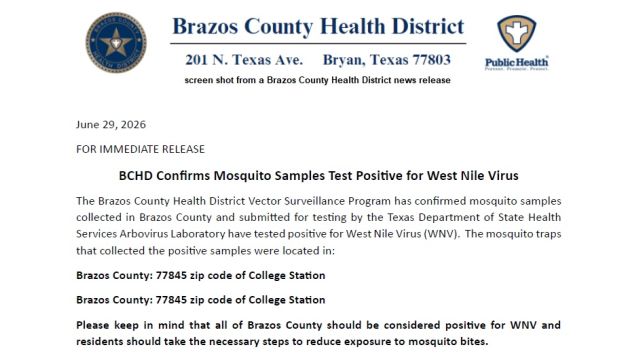
The Brazos County health district has announced for the first time this summer, finding mosquitos testing positive for West Nile virus.
Infected mosquitos were found in two traps, both in the College Station zip code of 77845.
While most people who are exposed to West Nile do not get sick, about 20 percent develop symptoms that includes headaches, fatigue, body ache, and nausea.
Measures to reduce being exposed to mosquitos includes draining standing water, using repellent containing DEET, limiting outdoor time when mosquitos are most active, and wearing long, loose, and light colored clothing outside.
News release from the Brazos County health district:
The Brazos County Health District Vector Surveillance Program has confirmed mosquito samples collected in Brazos County and submitted for testing by the Texas Department of State Health Services Arbovirus Laboratory have tested positive for West Nile Virus (WNV).
The mosquito traps that collected the positive samples were located in:
Brazos County: 77845 zip code of College Station
Brazos County: 77845 zip code of College Station
Please keep in mind that all of Brazos County should be considered positive for WNV and residents should take the necessary steps to reduce exposure to mosquito bites.
The Brazos County Health District (BCHD) conducts Mosquito Surveillance with weekly trapping in both Cities of Bryan and College Station, beginning each May through the end of October to monitor for the presence of West Nile Virus, St Louis Encephalitis Virus, and Eastern Equine Encephalitis Virus.
BCHD staff also collects mosquitoes trapped by members of the Brazos Valley Vector Collaborative (BVVC) in the six adjacent counties of Burleson, Grimes, Leon, Madison, Robertson, and Washington. Traps are set by BVVC members every other week and samples are collected, prepared and shipped to the Texas DSHS Arbovirus Laboratory in Austin by the BCHD.
The Brazos County Health District has notified the other members of the Vector Surveillance and Control Partnership that includes the City of Bryan, City of College Station, Texas A&M University, and affected surrounding counties.
Enhanced surveillance including additional traps and larvicide treatments of confirmed breeding habitat in the area of the positive sample collection will begin as specified in the Brazos County Health District Phased Response Guidelines. Residents in all areas of Bryan, College Station, the Brazos Valley area, and surrounding counties should empty and eliminate any standing water in containers on their property and ensure that lawn irrigation and onsite sewage systems are functioning properly.
There are no medications to treat, or vaccines to prevent West Nile Virus infection. All Brazos County residents are urged to use the 4D’s to reduce exposure to biting mosquitoes:
• DEET All day, Every Day: Whenever outside, use and reapply insect repellents that have the active ingredient DEET or other EPA-registered repellents and always follow label instructions.
• Dress: Wear long, loose, and light-colored clothing outside.
• Dusk and Dawn: Limit spending time outdoors when mosquitoes are most active.
• Drain: Drain or treat with larvicide all standing water in and around your home or workplace where mosquitoes could lay eggs.
West Nile Virus is transmitted through the bite of infected mosquitoes. Most people exposed to the virus do not get sick, but about 20% develop symptoms like headache, fever, body aches, joint pains, nausea, and fatigue. In a very small portion, less than one percent, the virus affects the nervous system, leading to a more serious illness that can cause neck stiffness, disorientation, tremors, convulsions, paralysis, and even death.
For more information, visit our website at www.health.brazoscountytx.org