
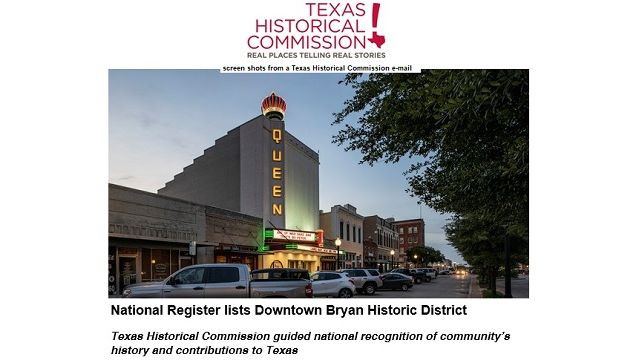
Downtown Bryan is now on the national register of historic places.
The city’s historic preservation officer, Allison Kay, says this completes a process that started in March 2023.
According to a news release from the Texas Historical Commission, 91 of the district’s 104 structures were described as having a sophisticated range or architectural styles dating back to 1880.
The national designation gives the owners of income producing properties the opportunity to receive federal tax benefits for what is described as sympathetic rehabilitation work.
Click below to hear comments from Allison Kay, visiting with WTAW’s Bill Oliver:
Listen to “Downtown Bryan is now on the National Register of Historic Places” on Spreaker.
News release from the Texas Historical Commission:
The Downtown Bryan Historic District in Brazos County was recently listed in the National Register of Historic Places with the assistance of the Texas Historical Commission (THC).
Noted for its historical significance, the new district joins other properties around the state with National Register status.
Originally platted by the Houston & Texas Central Railroad (H&TC) in 1866, the 37-acre-district served as a vital regional hub for the agricultural and cotton industries. Bryan’s unique diamond-shaped street grid and dense commercial core reflect the importance of the railroads, which funneled the wealth of the Brazos Bottom farmlands into the city.
The district epitomizes the classic evolution of a Texas railroad town, from its early boom years through its adaptation to the mid-century highway system.
The district features 104 built resources, including 91 contributing buildings that showcase a sophisticated range of architectural styles. While most buildings reflect the practical American Commercial style, the area is also home to high-style examples of Queen Anne, Art Deco, Streamline Moderne, and Mid-Century Modern design.
The district includes some of Bryan’s most notable landmarks, including the 1902 Bryan Carnegie Library, the La Salle Hotel, and the Queen Theater. These masonry structures, largely built between 1880 and 1940, replaced earlier wood-frame buildings following a series of devastating fires in 1909.
The district stands today as a testament to generations of successful preservation efforts in Bryan, maintaining a historic low-rise scale and mixed-use character that originally blended commerce, government, and institutional life.
About the Texas Historical Commission
The Texas Historical Commission is the state’s official historic preservation agency. It preserves, operates, and manages 42 state historic sites, the Texas Heritage Trails Program, Texas Main Street Program, Texas Historic Courthouse Preservation Program, and many more heritage tourism and historic preservation initiatives across the state. The Texas Historical Commission’s mission is to protect and preserve the state’s historic and prehistoric resources for the use, education, enjoyment, and economic benefit of present and future generations. For more information, visit thc.texas.gov.
About the National Register of Historic Places
The National Register of Historic Places is the nation’s official list of cultural resources deemed worthy of preservation. Authorized under the National Historic Preservation Act of 1966, the National Register is part of a federal program to coordinate and support public and private efforts to identify, evaluate, and protect the country’s historic and archeological resources. The National Register includes more than 3,300 listings in Texas. Income-producing properties are also eligible for federal tax benefits for sympathetic rehabilitation work.
To learn more about the National Register of Historic Places, visit thc.texas.gov/nrhp.